
Bitcoin, Crypto, BTC, Blockchain, CryptoNews, Investing are more than tags — they’re the lens through which every move in markets gets interpreted right now. A 52% pullback from October highs down to early-February lows has left a lot of investors asking whether a durable bottom is in place for Bitcoin. This piece walks through what the charts are telling us, why institutional and corporate flows changed the game, where risk is concentrated, and how to think about positioning across crypto, equities, and precious metals over the next few months.
Where we are: the short-term setup for Bitcoin
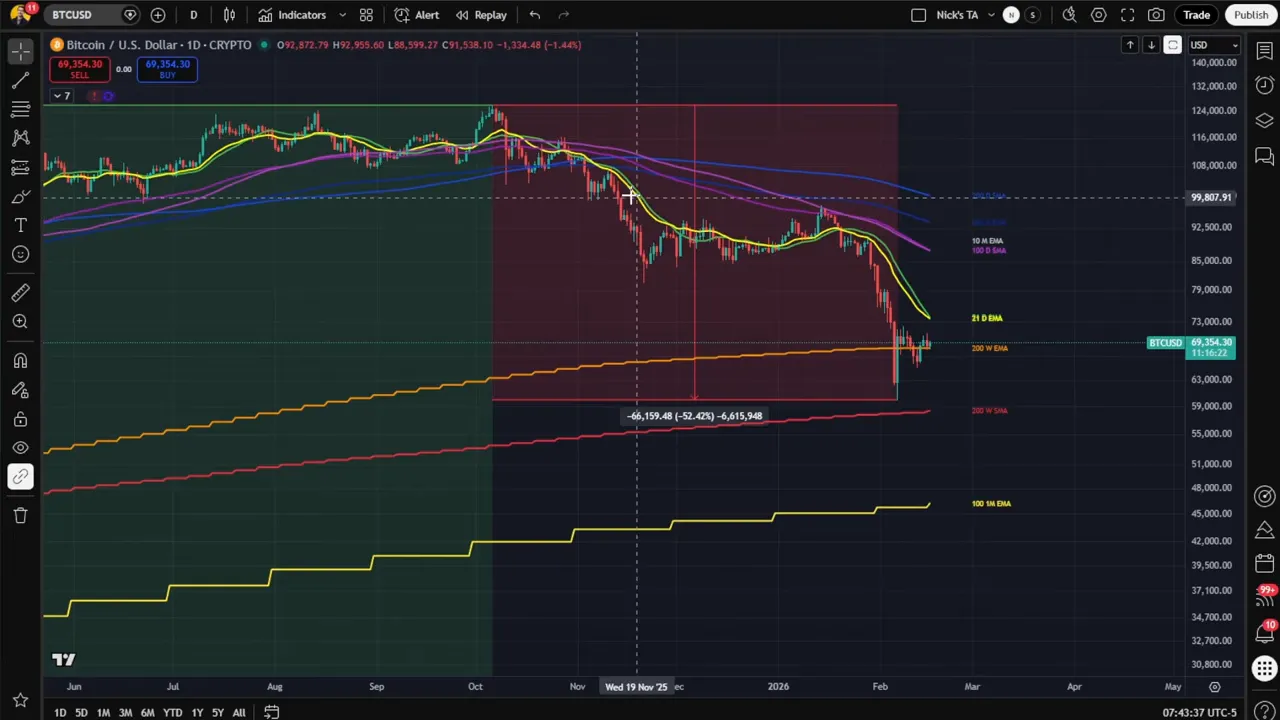
Price action matters first. After a sharp pullback — roughly 50% off the highs — the immediate question is whether Bitcoin can reclaim the technical territory that indicates stabilization. Two signals matter most for a short-term bounce:
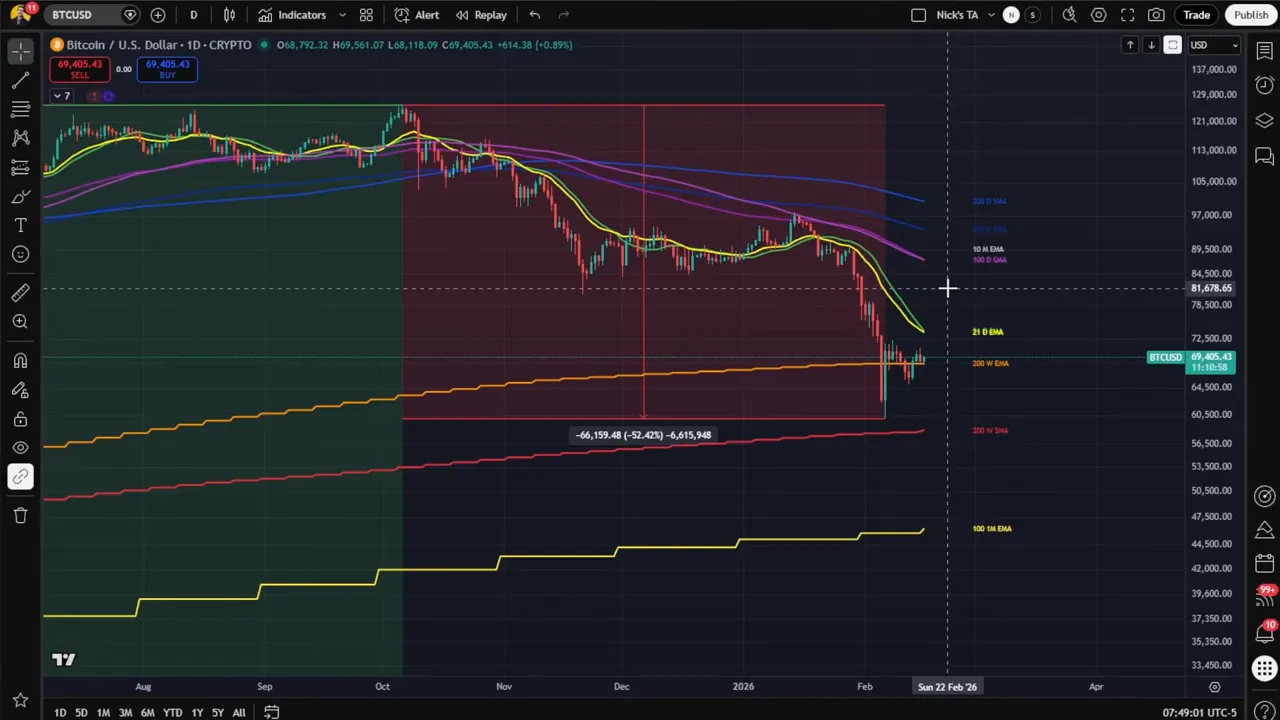
- Reclaiming the 21-day moving average. When price moves far from the 21-day, a reversion to the mean often follows. If BTC can climb back above the 21-day and press toward longer-term averages, a relief rally into the $80k–$85k band is within the realm of reasonable outcomes.
- 200-week support. The long-term 200-week moving average has been a structural bid. Holding that level and building higher lows is the textbook way a local bottom forms after heavy sell-offs.
If both of those hold, expect short-term tradable rallies. That doesn’t mean the cycle is over or that a new parabolic phase has begun — but it does offer tactical windows for traders to take advantage of a mean reversion move. For context on the market frame, remember that Bitcoin, Crypto, BTC, Blockchain, CryptoNews, Investing remain top-of-mind for every allocation discussion right now.
What a relief rally looks like
Relief rallies are typically stair-stepped. You’ll see short, aggressive moves up that retrace part of the sell-off, followed by consolidation and either a renewed leg higher or another leg lower. In practical terms:
- Expect volatility. Moves above the 21-day may be sharp and driven by short-covering and tactical buying.
- Take profits along the way rather than assuming a straight-line run to new highs.
- Watch altcoin dynamics — sometimes they outperform on relief ripples; sometimes they lag until BTC stability is confirmed.
And yes, from an SEO and conversation perspective, the topics of Bitcoin, Crypto, BTC, Blockchain, CryptoNews, Investing keep coming back because they are the framework for how investors think about allocation, risk, and opportunity today.
Why Bitcoin tanked: institutional and corporate flows changed the rules
The market environment that allowed Bitcoin to run up in previous cycles is different today. Two structural buyers used to act as the reliable engines of demand:
- Spot ETFs and institutional flows — big dollar inflows to spot Bitcoin ETFs created substantial, predictable bid days that supported higher prices.
- Corporate treasuries — public companies buying Bitcoin and holding it as a corporate asset created another consistent layer of demand.
Over the last year, those engines have shifted. ETF inflows have become more inconsistent and, at times, turned to net outflows. When the ETFs are net negative in spot Bitcoin consumption, the supply/demand balance is challenged and price momentum weakens. This structural dampening of demand helps explain why Bitcoin fell despite periodic big buyers stepping in.
It’s worth repeating the lens: Bitcoin, Crypto, BTC, Blockchain, CryptoNews, Investing are tightly coupled to where institutional capital chooses to allocate — and that allocation has become less one-directional.
Reading the ETF data
Two useful ways to read ETF impact:
- Dollar flows — how much capital is entering or leaving ETFs in fiat. Large positive days supported the prior uptrend; increasing frequency and size of outflows are a warning sign.
- Bitcoin consumption — the actual number of BTC bought or sold by ETFs. It directly changes available supply.
When both metrics go neutral or negative for sustained periods, momentum dries up. That’s a structural backdrop for lower highs and deeper corrections until new types of buyers emerge or existing buyers return in force.
MicroStrategy: the elephant in the room
One corporate name dominates the conversation: MicroStrategy. It’s not an exchange, it’s not a cold wallet in a broad distribution — it’s a public company that has intentionally built a large BTC position using debt and balance sheet resources.
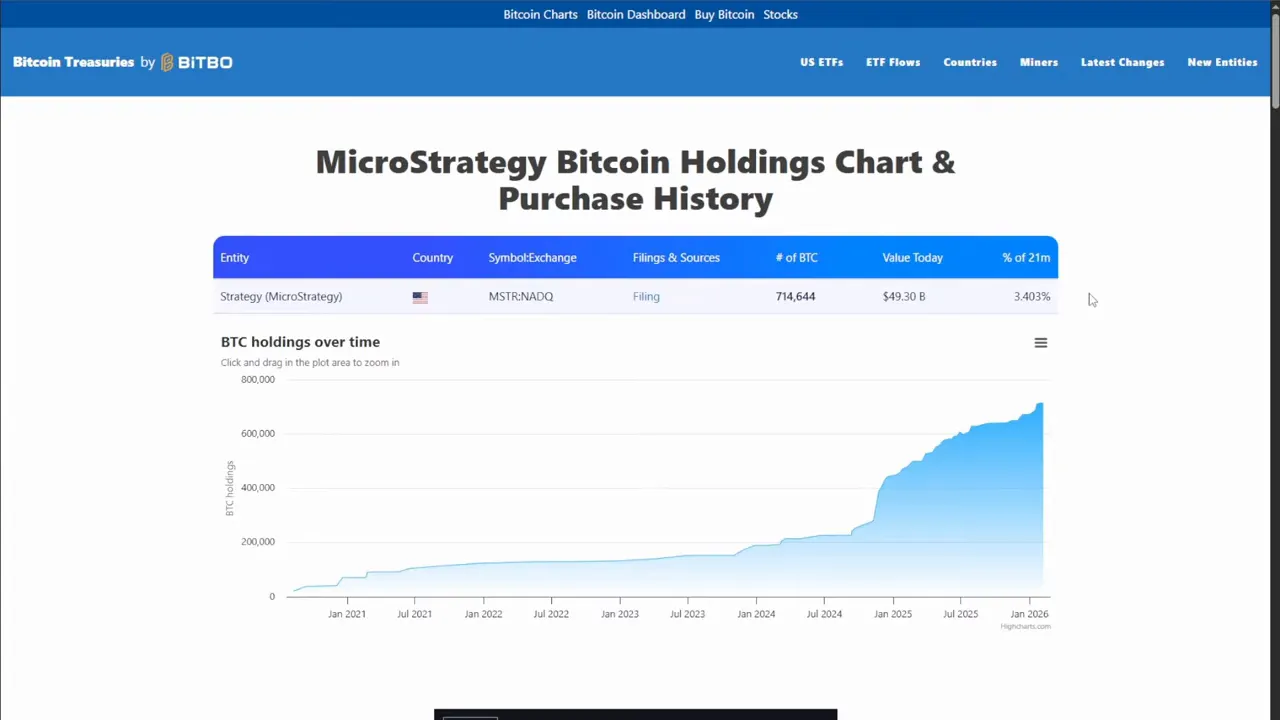
Between the cyclical highs and the recent lows MicroStrategy acquired roughly 70,000 additional Bitcoin. Yet during that same period, market price declined by roughly 50%. That disparity highlights a few painful realities:
- Concentration risk. Large, single-entity holdings act differently than distributed holdings. If sentiment turns, the market reacts not just to Satoshi or exchange-held coins, but to the behavior and constraints of concentrated corporate buyers.
- Liability-driven selling. MicroStrategy has debt maturities and obligations. If the macro environment turns sour — equities falling across the board — the company may need to raise cash, refinance under worse conditions, or sell BTC to meet debt payments.
- Psychological impact. Heavy corporate buying once reassured markets. Now the market asks: who will buy if big corporate buyers can’t keep adding without introducing systemic risk?
That last point is crucial: Bitcoin used to have one narrative — scarcity meets growing demand. Now the narrative includes balance-sheet mechanics, refinancing risk, and the question of buyer breadth. Bitcoin, Crypto, BTC, Blockchain, CryptoNews, Investing conversations must factor in balance-sheet realities when assessing upside potential.
MicroStrategy’s limits aren’t just liquidation risk
MicroStrategy’s leadership has suggested liquidation levels are far below current prices, implying comfort. But liquidation is only one channel by which their BTC position can affect markets. The other is cash flow needs. Paying interest, rolling debt, and covering corporate expenses can create selling pressure even if outright liquidation thresholds haven’t been hit.
That nuance matters because it changes how a market digests incremental buys from a company like MicroStrategy: purchases may not signal uninterrupted accumulation; they can be a stopgap or tactical move while long-term liabilities loom.
Short-term trading vs. mid/long-term investing
Different horizons require different rules. For traders, short-term reclaims of the 21-day and moves into the 80k–85k band are actionable. For investors with longer horizons, the broader macro picture dictates whether those rallies are buying opportunities or traps.
- Traders — use risk-defined entries, scale into moves above the 21-day, and take profits on strength. Consider smaller degree leverage only if risk controls are in place.
- Investors — avoid averaging blindly into weakness without a framework for where systemic risk resides. If equities and commodities turn lower as part of a broad de-risking, crypto correlations can increase and amplify downside.
Across both approaches, the statement “don’t expect a straight-line march to new all-time highs” is a practical rule. Bitcoin, Crypto, BTC, Blockchain, CryptoNews, Investing are all subject to macro cycles; reflexive optimism without risk management is a recipe for being “bagged” when the music stops.
Altcoin dominance and short-term rotation
Altcoins sometimes rally when Bitcoin stabilizes. Right now, there are signs of altcoin life: meme coins, AI plays, and select DeFi names have popped in small windows. That’s normal. Two structural notes on alt rotation:
- Dominance cycles matter. Alt dominance rising above key moving averages suggests risk appetite is returning, at least temporarily. Those moves often coincide with relief rallies in BTC.
- Be earlier, not later. Multiples in alt markets are rarely as explosive as they used to be once retail and institutional access mature. The best returns come from being ahead of narratives rather than chasing post-mania.
Short-term opportunities exist, but they are not identical to the multi-year moonshots of previous cycles. Bitcoin, Crypto, BTC, Blockchain, CryptoNews, Investing all remain theme anchors — but the payoff curves have changed.
Wider markets: equities flashing warning signs
The bigger, scarier part of the thesis is not whether BTC ticks up for a few weeks. It’s whether global risk assets are entering the phase where a long secular expansion ends or at least pauses for a prolonged correction.
What to watch in equities:
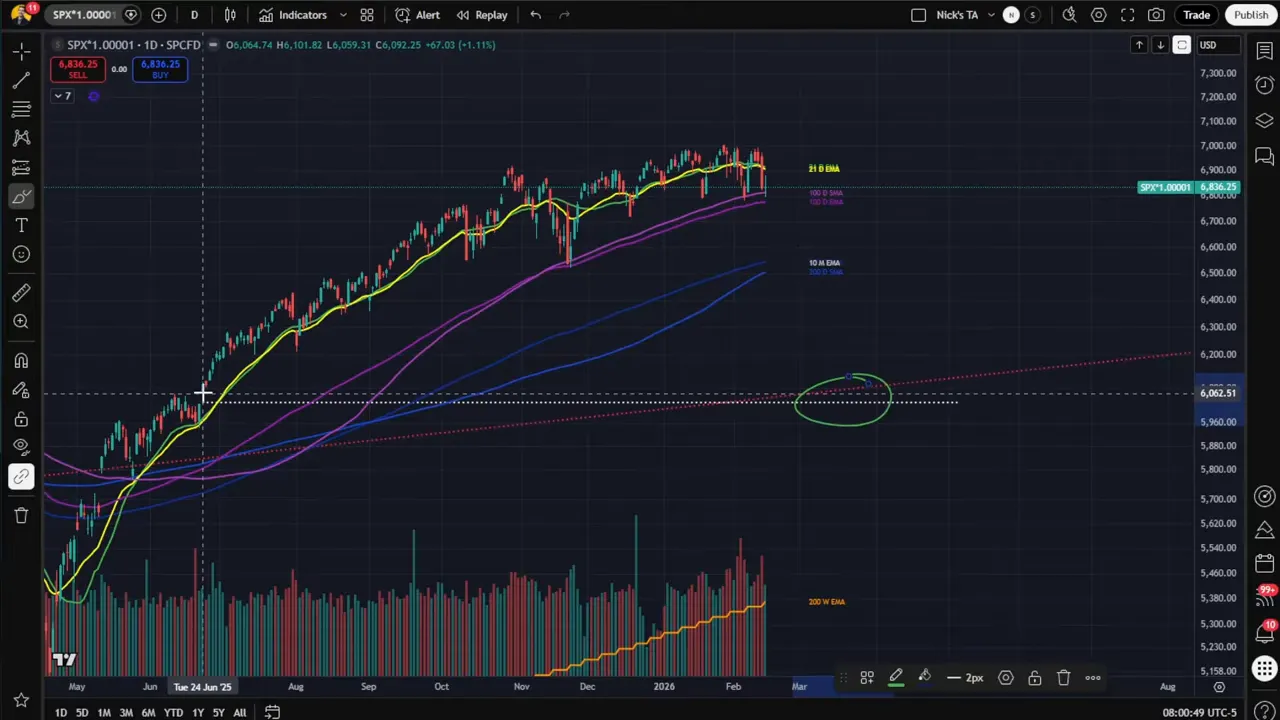
- Moving averages flipping roles. The 21- and 100-day moving averages have been acting as magnets and support in earlier phases. When they flip to resistance, the speed of expansion slows and corrections deepen.
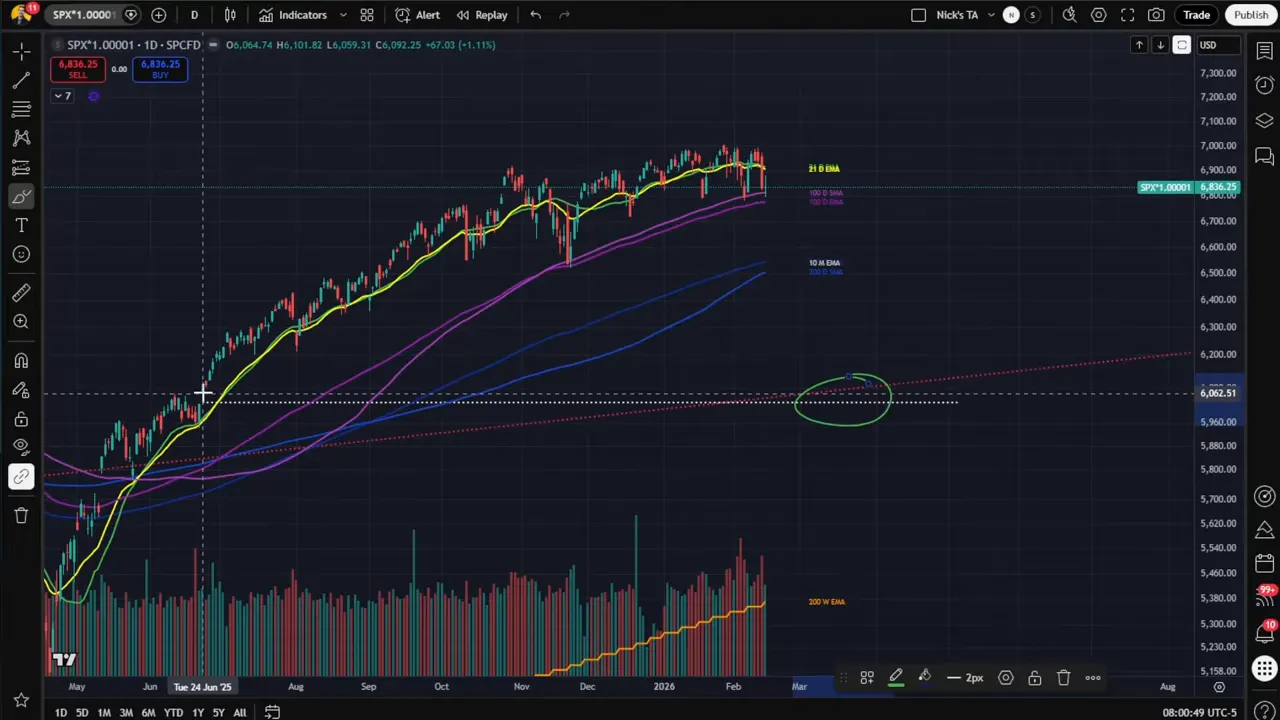
- Gap fills and long-term resistance lines. The S&P 500 has structural gap zones and a very long historic resistance line around certain levels. If price reclaims that line as support after a gap-fill, a new leg up is possible. If it fails, a much larger correction becomes more likely.
- Chopping into moving averages. If indices chop below the 100-day and then struggle to break back above, that’s often a prelude to deeper pullbacks toward the 200-day.
My working target to watch on the S&P is a gap-fill zone around 6,000, which would be the area where prior resistance from decades past becomes a potential support. If the market finds support there and treats the line as a base, it can be the springboard for another expansion. If it fails, it’s a clear signal to de-risk risk assets, including crypto.
NASDAQ and the technology cycle
The NASDAQ deserves special attention. It has not set a new high since October and has already used the 21- and 100-day averages as resistance in multiple attempts. A move to the 200-day and a gap-fill from earlier in the prior year is entirely plausible. That scenario is not extreme — it is a 15%–18% correction — but when taken with other signals, it points to a market that’s more fragile than many expect.
Remember: even a 15%–20% correction in equities can easily reverberate into crypto because of correlated flows and risk-on/risk-off dynamics. Bitcoin is not immune to macro risk, despite its unique narrative.
Commodities and precious metals: late-stage signals
Precious metals have already rallied significantly. Commodities are often the late-arriving indicator — they catch up once equities and risk assets have already run higher for a while. That makes recent strength in gold and silver an important signal, not the final proof on its own.
Silver in particular has been volatile and historically prone to multi-year cycles where highs can be tested and then fail multiple times before a definitive bottom or new trend appears. A gap-smack or flash down can be a powerful sign that a speculative phase has exhausted itself.
If precious metals have topped in the near-term while equities are showing signs of stalling, the combination is a classic late-cycle indicator. It’s not a guarantee for a devastating collapse across all assets, but it increases the probability that risk assets will experience deeper mean reversion.
Once again, place this in the framing: Bitcoin, Crypto, BTC, Blockchain, CryptoNews, Investing are all sensitive to where capital flows when the macro narrative shifts from expansion to contraction.
Where to hide (and where not to hide) if risk assets break
When the music stops, the immediate instinct is to avoid holding cash. There’s a narrative that central banks will print and devalue currencies, so being in cash feels like “losing” by default. Reality is messier.
- Cash and high-yield liquid placements are underrated in a market drawdown. Having liquidity allows you to buy at lower prices and deploy capital after the worst of the selling happens.
- Assets that decline plus currency debasement are double punishment. If you’re forced to sell assets during a drawdown, the timing and price matter far more than theoretical future printing.
- Yield-bearing liquid instruments — short-term Treasuries, high-quality money market funds, or short-duration instruments that provide yield without excessive price volatility — are pragmatic places to park capital until the dust settles.
Important caveat: hyperinflation scenarios are rare and extreme. For the typical investor, the balanced approach is to preserve optionality with cash and liquid yield while keeping a playbook to buy meaningful dislocations.
For crypto-native investors, that might mean keeping a portion of capital in stablecoins on reputable platforms or custody, ready to deploy into quality selling. For broader investors, it’s about trimming exposure and keeping dry powder to take advantage of severe market dislocations.
Portfolio actions to consider now
Here are practical, tactical actions that map to different risk tolerances and timeframes:
- Conservative: Reduce directional exposure to risk assets. Increase cash or short-duration yield. Keep a clear buy plan for meaningful market weakness.
- Moderate: Take profits on large winners, scale into stablecoins/cash, and keep a checklist of macro signals that would trigger incremental buys (e.g., gap-fill plus moving average support confirmed).
- Aggressive: If comfortable with high drawdowns, set staggered buy levels for BTC and selected altcoins below current price. Use tight position sizing and risk management because the market can remain irrational longer than expected.
Across all buckets, the golden rule is clear: define where you will add, and do not add as a reflex to headlines without a plan. Bitcoin, Crypto, BTC, Blockchain, CryptoNews, Investing are all part of a larger allocation decision — not a stand-alone ticket to unlimited upside without risk controls.
Behavioral traps and mental models
Markets punish common behavioral mistakes:
- Blind averaging — adding to losing positions without a thesis or stop can be destructive.
- FOMO on every bounce — assuming every rally is the start of a new bull run leads to being whipsawed.
- Overconfidence from recent gains — recent outperformance creates complacency. Remember history: extended expansions are followed by meaningful corrections.
Good habits: write down your plan, include targets and stop rules, and test emotions against facts. When the market is noisy, process-driven approaches win over gut instincts.
What a multi-asset downturn could look like
If the worst-case plays out — gap fills, long-term resistance failing, and broad deleveraging — the world could see a 40%–50% drawdown in equities and correlated assets. Crypto would likely be hit harder in percentage terms because of leverage and cross-asset flows.
That scenario is not the base case; it’s a plausible tail risk. The difference between a garden-variety correction and a full reset is the speed of de-risking and how central banks respond. Historically, the biggest corrections coincide with long-term credit tightening, valuation extremes, or exogenous shocks.
Prepare for both paths: an orderly mean-reversion that creates buying opportunities, or a deeper correction that requires patient accumulation and risk control.
Practical trade setups and watchlist items
For traders and active allocators, here are concrete items to watch and trade:
- BTC reclaim of 21-day — if BTC reclaims and holds, look for short-term swing entries with tight risk management and predefined profit targets.
- Altcoin rotation — monitor dominance metrics and rotate into higher-quality alts that show relative strength during BTC relief rallies.
- S&P gap-fill and 200-day — use the gap-fill area as a framework for scaling exposure. If price treats the area as base, increase exposure; if it fails, reduce exposure aggressively.
- MicroStrategy equity vs BTC — watch MSTR’s share action relative to BTC. Short-term, MSTR can outperform BTC on an oversold stock bounce; long-term, its balance-sheet dynamics remain a risk.
Each setup should include position size, stop, and target. Avoid the common mistake of trading setups without a risk exit.
How to think about opportunities without getting reckless
Opportunities look different today than in prior cycles. With broader access to crypto and more institutional involvement, rallies may be shallower and less frequent unless macro liquidity conditions tilt aggressively toward easing.
To capture upside without getting reckless:
- Be early to trends but small: allocate small, staggered positions rather than going all-in on narratives.
- Focus on quality projects and reputable counterparties to reduce execution and custodial risk.
- Keep a multi-asset view: crypto can outperform in select regimes, but correlations rise during panic. Have a plan for cross-asset drawdowns.
It’s tempting to chase calls for 200k or 300k BTC. Those outcomes are possible under certain macro conditions, but not inevitable. Build for optionality and protect capital first.
A realistic outlook for the coming months
Short-term: a relief rebound into the 80k band for BTC is plausible if the 21-day is reclaimed and ETFs stabilize. MicroStrategy and certain altcoins may offer tactical bounces.
Medium-term: the broader macro picture — equities, commodities, and precious metals — will dictate whether those bounces are a pause or the start of a new expansion. If indices gap-fill and hold long-term support, a new leg up becomes more likely. If they don’t, drawdowns deepen and cash becomes a strategic asset.
In every scenario, return to basics: risk management, plan-driven entries, and liquidity to buy real dislocations. And yes, the set of conversations labeled Bitcoin, Crypto, BTC, Blockchain, CryptoNews, Investing will persist because these themes sit at the intersection of technology, finance, and macro policy.
Where I’m watching closely (checklist)
- BTC above the 21-day and reaction at long-term moving averages
- Spot ETF inflows vs outflows and total BTC consumption by ETFs
- MicroStrategy debt schedule and any signs of balance-sheet-driven selling
- S&P 500 gap-fill around 6,000 and whether it becomes support
- NASDAQ response to the 200-day and gap-fill from the previous year
- Gold and silver’s reaction at 100-day levels and whether commodities remain elevated
Voice of caution with a readiness to act
Caution is not pessimism; it’s preparation. Markets have cycles, and the rules of engagement evolved as institutional and corporate flows reshaped the crypto landscape. Keep liquidity, insist on risk-defined positions, and look to add to allocations only when your checklist signals a higher probability setup.
Bitcoin, Crypto, BTC, Blockchain, CryptoNews, Investing are themes worth staying engaged with — but engagement must be disciplined. The road ahead offers opportunity, but it also asks for humility.
Final thoughts and action plan
There’s no magic answer that applies to everyone. If you prefer a simple framework to follow this season, try this:
- Define your horizon: trading, swing, or multi-year investing.
- Set specific trigger points where you will add, trim, or exit positions (moving averages, gap-fills, and ETF flows are great anchors).
- Hold cash or yield instruments ready to deploy into dislocations.
- Keep position sizes small relative to total net worth if you are in risky, high-volatility assets.
- Reassess quarterly and after major macro events; don’t anchor to a single narrative.
This plan isn’t sexy, but it preserves optionality when outcomes are uncertain. Most importantly, it avoids the single biggest mistake: getting caught holding the bag when a broad correction finally arrives.
If you track market moves with these markers in mind, you’ll be able to respond rather than react. Bitcoin, Crypto, BTC, Blockchain, CryptoNews, Investing will continue to generate headlines and headlines can be loud — but steady, process-driven decisions win over time.
Bitcoin, Crypto, BTC, Blockchain, CryptoNews, Investing — Did BTC Hit a Real Bottom After a 52% Crash?. There are any Bitcoin, Crypto, BTC, Blockchain, CryptoNews, Investing — Did BTC Hit a Real Bottom After a 52% Crash? in here.

