
Bitcoin, Crypto, BTC, Blockchain, CryptoNews, Investing headlines love a dramatic hook. Over the weekend we had one: a U.S. operation targeting Venezuelan leadership, altcoins and BTC moving green, and a torrent of influencers claiming the whole thing will “rocket XRP to the moon” because—wait for it—oil. If you live for Bitcoin, Crypto, BTC, Blockchain, CryptoNews, Investing drama, pull up a chair. If you prefer clarity over hype, read on.
This piece cuts through the noise. We’ll break down what actually matters for XRP price action right now, why Venezuela-oil-to-XRP narratives are mostly hot air, what David Schwartz’s new role means for the XRP Ledger, and how to think like a trader or investor in a market that loves to be loud but rarely tells the whole truth.
Market snapshot: green screens, low volume, and what that really means
Everyone loves green. The market showed an across-the-board uptick: BTC above recent resistance, many altcoins printing double-digit percentages, and XRP flirting with the low-$2s. That’s nice. But look closer: volume was anemic. When price moves happen on low volume, they tend to be fragile and short-lived.
- Why volume matters: Volume confirms conviction. High price movement with low volume is often retail knee-jerk buying or a temporary squeeze. Without real capital behind the move, sellers can push price back down quickly.
- Correlation, not causation: When the entire board is green, it’s rarely one isolated fundamental story propelling every token. Broader macro flows, sentiment, and short-term positioning often spread across assets simultaneously.
- RSI warning: XRP’s short-term RSI was showing overbought readings, which often precedes consolidation or corrections unless big new capital enters the market.
So celebrate the green, but don’t confuse a parade with a revolution. If you’re trading, tighten stops. If you’re investing, use green days to reassess allocation rather than doubling down blindly.
Venezuela, oil, and the influencer echo chamber
Headline: U.S. action in Venezuela. Predictably: a flood of hot takes claiming Venezuelan oil revenues will be denominated in XRP and that Venezuelans will instantly pivot to Stellar XLM or Ripple XRP to “escape” sanctions. Here’s the cold, practical read.
Why this narrative is seductive
It’s emotionally appealing: a crisis + a convenient crypto answer = instant hero myth. Influencers love it because it gets clicks and loyal followers. The idea that a nation’s oil industry will pivot to a single crypto overnight is great content. It is not great economics.
Why the story is mostly nonsense
- Trade infrastructure isn’t flip-a-switch. State-level invoicing, international banking relationships, and commodity contracts are complex. Choosing a payment rail for oil involves legal, settlement, custodial, and political layers—not a tweet.
- Dollar dominance. The U.S. dollar remains the dominant invoicing currency for commodities. Replacing that requires massive institutional shifts, sanction workarounds, and banking partners willing to take on geopolitical risk.
- Liquidity and on/off ramps. For a commodity like oil, buyers and sellers need reliable fiat rails, custody solutions, hedging instruments, and insurance. Crypto rails presently don’t replace those functions at the scale of national oil trade.
- Regulatory and enforcement risks. Any nation moving to a new settlement rail risks secondary sanctions, blocked counterparties, and frozen reserves. The easiest path for many countries is complex and slow—not overnight adoption of one token.
That doesn’t mean crypto won’t play a role in international payments or remittances in the future. It means that headlines promising immediate mass adoption for one token because of a geopolitical event are usually selling a story, not reporting an outcome.
Call-out culture: how influencers weaponize headlines
When a big geopolitical event breaks, many content creators see an opening. They stitch together half-truths, blind optimism, and aggressive price targets to create viral headlines. The agenda isn’t always obvious: sometimes they want clicks, sometimes subscribers, sometimes products sold via affiliate links and merch.
Spot the pattern: big claim → vague mechanism → specific price target → “subscribe and buy my course.” The mechanism is almost never independently verified. That’s why skepticism is your best defense.
David Schwartz moves to CTO Emeritus: what it actually means
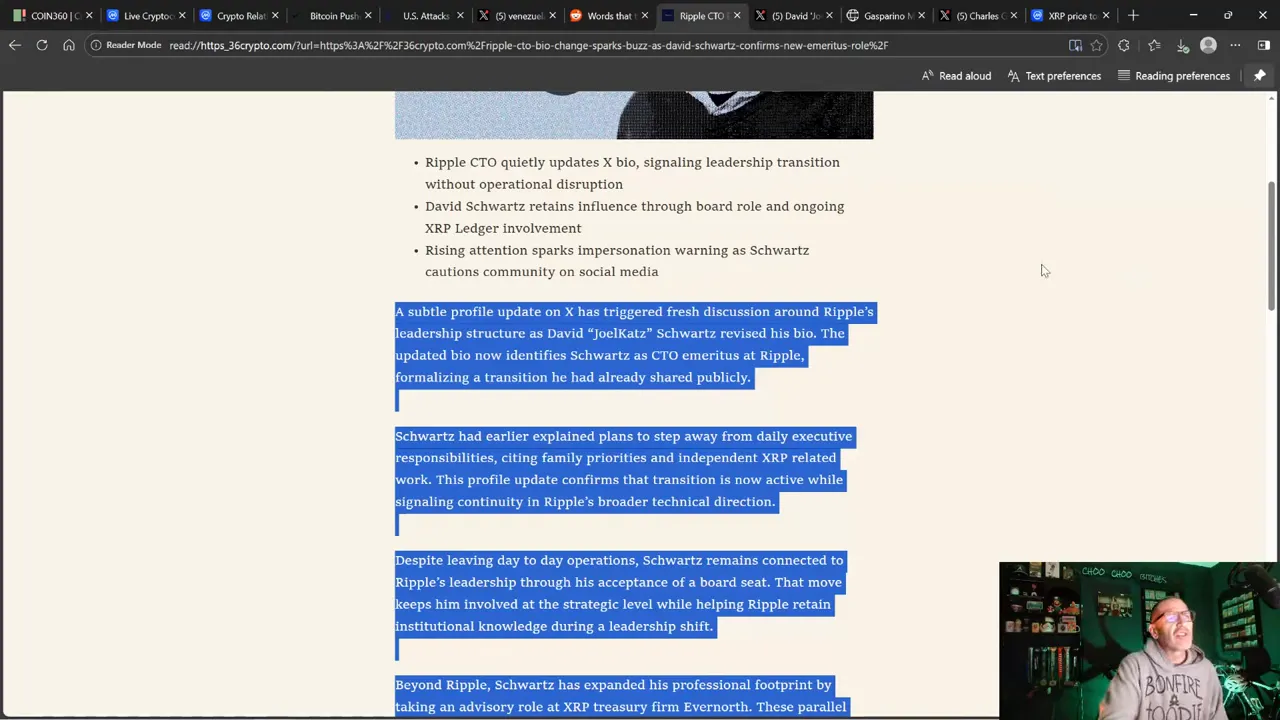
News: David Schwartz updated his profile to “CTO Emeritus” at Ripple and is advising another firm focused on XRP-related treasury activities. That’s not a scandal. It’s a pivot. Here's a measured read on what this means for the XRP Ledger and for Ripple.
CTO Emeritus: stepping back without vanishing
Emeritus generally means stepping away from day-to-day operational responsibilities while keeping a connection and the ability to advise. For someone like David, who helped architect the XRP Ledger, this change fits a pattern: shift focus to family, independent XRPL work, and advisory roles.
This isn’t a “loss” for XRP. It’s leadership evolution. Developers and founders often transition to advisory roles once projects scale. David’s continued involvement with XRPL-focused initiatives suggests ongoing technical engagement outside Ripple’s direct corporate work.
Advisory role at an XRP Treasury firm
Advising an XRP treasury firm signals two things:
- David’s interest in infrastructure-level work that directly supports XRPL liquidity and treasury management.
- A recognition that building sustainable use cases requires treasury solutions, custody, and protocols that operate outside of one corporate entity.
That can be positive. Strong treasury and custody infrastructure helps institutions consider XRP for real use cases—if and only if regulatory clarity and counterparty trust exist.
Gasparino’s takedown and the trader vs holder debate
Financial commentator Charles Gasparino didn’t mince words: retail holders get mocked because many retail participants treat the asset like an investment while acting like traders. That’s a key distinction that deserves attention.
Trader vs investor: define your role
- Trader: Seeks short- to medium-term gains via timing, volatility, and technical setups. Trades actively, takes profits at targets, and often rotates between assets.
- Investor: Allocates capital for long-term appreciation based on fundamental beliefs—technology adoption, macro trends, tokenomics, or network effects.
Many XRP participants fall somewhere in between. They cheer for long-term price predictions but take profits during spikes. That’s perfectly fine—just be honest with yourself. If you sold at $3.40 and re-entered lower, you’re a trader. If you’re waiting for a decade to pass, you’re an investor. Both strategies require different risk management.
Why critics have a point
When celebrities, financial journalists, or influencers constantly highlight price targets and dramatic narratives but don’t disclose motives or trading histories, skepticism is reasonable. Markets are emotional; people get manipulated by FOMO and hype.
Gasparino’s critique isn’t about XRP’s utility. It’s about the gap between what some people preach (hodl forever, payback at insane multiples) and what they practice (timing, trades, product pushes). Recognize that and adjust your strategy accordingly.
Technicals versus narratives: what’s actually moving price right now?
There are two basic categories of drivers for crypto price movement: technical market factors and fundamental narratives. Too often, people collapse the two and say one caused the other when correlation is all that exists.
Technical factors to watch
- Volume: Low volume rallies are high risk. Look for sustained bids across exchanges and institutional order flow to confirm a genuine uptrend.
- RSI and momentum signals: Overbought levels can indicate short-term exhaustion. Use them with context—on a strong institutional influx, RSI can stay elevated for a long time; without it, RSI is a warning.
- Support and resistance zones: Identify key levels from months of price action. These matter more than clickbait narratives.
- On-chain metrics: Exchange flows, long-term holder accumulation, and active addresses provide context beyond price charts.
Fundamental narratives that actually matter
- Regulatory clarity: Institutional participation rises when regulators provide clearer guidelines. A court decision, law, or favorable guidance can unlock capital.
- Real-world partnerships with enforceable contracts: Token utility comes from real contracts and flows. Pilot programs, treasury solutions, and settlement partnerships with banks matter more than Twitter rumors.
- Liquidity and custody solutions: Institutional players need secure custody and predictable liquidity. Advances here change the playing field.
Which brings us back to Venezuela: none of those systemic enablers are solved by a single tweet. That’s why the hot takes are convenient, not credible.
How to parse headlines and influencer takes (practical checklist)
Stop reacting. Start filtering. Here’s a compact checklist to decide whether a headline or influencer claim deserves your capital.
- Ask for specifics: Who exactly will sign contracts? Which banks? What legal framework?
- Check for verification: Is there a primary source? Government statement? Bank release? Or just someone’s social post?
- Look at liquidity: Are exchanges showing real order book depth or just a thin top-layer bid?
- Decide your role: Are you trading the volatility or investing for long-term fundamentals? Use rules that fit that choice.
- Risk manage: Use position sizing, set stop-losses or profit targets, and don’t overleverage on faith.
- Diversify thinking: No narrative is cult-proof. Spread exposure across assets and strategies.
If you want to act on an influencer claim, require confirmation from at least two credible institutional or regulatory sources. If the claim hinges on a “will happen” promise with no contract or pilot, treat it as entertainment, not intel.
Practical strategies for short-term traders and long-term holders
Your approach to XRP or any crypto must match your risk tolerance and goals. Below are actionable tactics tailored to both camps.
For short-term traders
- Trade the volatility: Enter based on clear setups—breakout with volume, mean-reversion at defined support, or momentum continuation with high liquidity.
- Use tight risk controls: Define stop-loss levels before you trade. Volatility can spike and wipe out unstopped positions.
- Lean on multiple timeframes: Use hourly charts for entries, daily charts for trend context, and weekly to avoid getting crushed by noise.
- Be selective about news trades: Not every headline is tradable. Only react if there's clear market-moving evidence (e.g., contractual announcements, regulatory approval, significant exchange listings).
For long-term holders
- Focus on fundamentals: Track on-chain metrics, developer activity, partnership announcements, and legal clarity.
- Dollar-cost average: Volatility can be a friend. Use DCA to build positions without timing risk.
- Keep capital aside for opportunistic buys: Short-term dips in overhyped markets create buying windows.
- Rebalance periodically: If a single position balloons past your risk tolerance because of a pump, rebalance to maintain portfolio health.
Both traders and investors benefit from keeping skepticism high and capital allocation disciplined.
Common XRP myths—debunked
Let’s tackle the myths circulating every time a geopolitical event happens.
- Myth: A single geopolitical event will instantly make XRP the settlement rail for a country. Reality: Adoption requires contracts, counterparties, custodians, and legal frameworks. Not a tweetstorm.
- Myth: Token supply issues alone will catapult price to insane targets. Reality: Supply matters, but demand and real use cases with liquidity matter more. A small float without buyers doesn’t equal price.
- Myth: Executives and early insiders profit at retail expense. Reality: Yes, key insiders have realized gains at various points. That doesn’t mean the asset has no future, but it signals how markets can be manipulated by liquidity control.
- Myth: ETF flows explain every altcoin move. Reality: ETFs matter for BTC and sometimes ETH, but altcoin moves often stem from other market dynamics like liquidity cycles, memecoin mania, or token-specific news.
When a story is worth acting on
Stories about geopolitical shifts, adoption, or partnerships are only actionable when they meet a few criteria:
- Confirmed counterparties: named banks, exchanges, or governments with verifiable contracts.
- Operational detail: how settlement will happen, custody arrangements, and who will provide liquidity.
- Regulatory backstop: at least some legal framework or precedent to support cross-border use.
- Market readiness: sufficient order-book depth and custodian support to handle institutional flows.
Absent those, most narratives remain: stories for clicks. Don’t bet your capital on a story alone.
How to read a price pump intelligently
Price moves attract noise. Here’s a quick filter you can run in under a minute:
- Check volume across top exchanges. Is it concentrated or widespread?
- Look at exchange inflows/outflows. Are wallets moving coins off exchanges (accumulation) or onto exchanges (selling pressure)?
- Scan for real headlines: partnership press releases, regulatory moves, or institutional filings.
- Set a scenario plan: if price breaks a key support, what steps will you take? If price breaks higher, where are your profit targets?
Make decisions based on verification, not emotion.
What David Schwartz’s pivot suggests about XRPL’s future
David’s move to an emeritus/advisory role and engagement with XRPL-focused treasury work indicates the ecosystem is maturing. I’ll say it plainly:
- Founders and architects moving into advisory roles is normal. It often signals a project is transitioning from startup phase to infrastructure phase.
- Technical stewardship outside of Ripple can diversify development and reduce single-entity risk for XRPL.
- Treasury and custody work is crucial. If firms build reliable treasury services for XRP, that lowers barriers for institutional usage—provided legal clarity exists.
This is a pragmatic signal. It doesn’t guarantee price moves, but it does indicate continued technical and institutional focus.
Final thoughts and a pragmatic checklist for the week
Crypto markets combine narrative-driven emotion and technical reality. When big headlines show up—Venezuela, oil, sanctions—expect two things: opportunists spinning stories for attention, and noise that briefly moves price. Both are normal.
Your job is to separate the durable signals from the transient noise. To sum up what to do next week and beyond:
- Stay skeptical of grand narratives without proof.
- Trade the market you see, not the market you want.
- Verify sources before acting on geopolitical claims tied to price movement.
- Maintain strong risk management whether you trade or invest.
- Watch regulatory signals—they matter more than hot takes for long-term capital inflows.
If you prefer bite-sized action items, here are three moves to consider:
- For traders: tighten stops and identify short-term support. Don’t chase pumps on low volume.
- For investors: track on-chain metrics and the pace of institutional infrastructure (custody, treasury services, exchange capabilities).
- For curious observers: read primary sources. Government releases, bank filings, and legal documents beat Twitter every time.
And one more reminder: the appeal of Bitcoin, Crypto, BTC, Blockchain, CryptoNews, Investing is massive—but so is the temptation to monetize anyone’s fear or hope. Keep your skepticism, your capital allocation rules, and your sense of humor intact.
You’ll see dramatic headlines next week and the week after. Most will be noise. A few will be signal. Your edge is the ability to tell the difference and act with discipline.
Bitcoin, Crypto, BTC, Blockchain, CryptoNews, Investing: XRP, Venezuela Oil Drama, David Schwartz and Why You Shouldn’t Believe Every Hot Take. There are any Bitcoin, Crypto, BTC, Blockchain, CryptoNews, Investing: XRP, Venezuela Oil Drama, David Schwartz and Why You Shouldn’t Believe Every Hot Take in here.

